Ellsworth Kelly’s exhibition started in Portland
Universally recognized as one of the most important American artists of the last fifty years, Ellsworth Kelly has redefined abstract art through his bold paintings, sculpture, prints, and drawings.
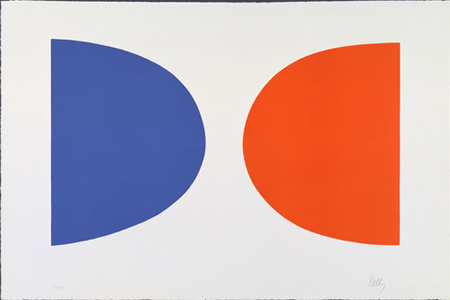
Blue and Orange from Suite of Twenty-Seven Color Lithographs, 1965
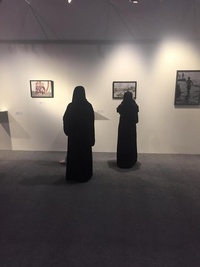
Ellsworth Kelly / Prints was organized by Portland Art Museum in cooperation with the Los Angeles County Museum of Art, which recently staged the first retrospective of Kelly’s prolific print practice since 1988. The Museum’s exhibition includes more than 80 prints drawn from the collection of Jordan D. Schnitzer and his family foundation. It explores Kelly’s use of key formal motifs: grids, chromatic contrast, right angles, and curves.
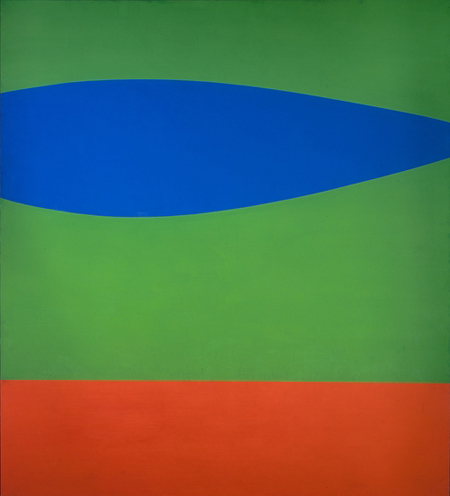
Blue Green Red, 1962
French abstraction greatly influenced the artist whose style changed drastically during his time in Europe when he was young. He abandoned figuration and traditional easel painting, choosing instead to create a vocabulary of simple geometric shapes in pure, vibrant color. Kelly’s visual vocabulary is drawn from observations of the world around him—shapes and silhouettes found in plants, architecture, shadows on a wall—and has developed from his interest in the space between places and objects and between his work and its viewer. Kelly has said, “In my work, I don’t want you to look at the surface; I want you to look at the form, the relationships.”
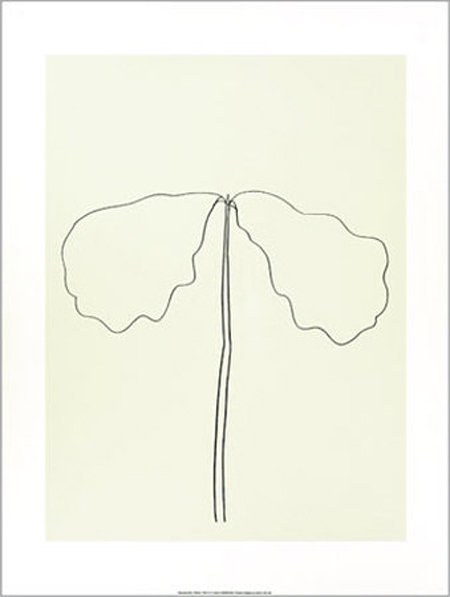
Chene, 1964
Born in 1923 in Newburgh, N.Y., Kelly studied at the Pratt Institute in Brooklyn until the age of 20, when he was drafted into the U.S. Army during World War II. He spent the majority of his military service in Europe. From 1948 through 1954, he lived in France, traveling and studying art and architecture. Nowadays he lives and works in Spencer, New York.
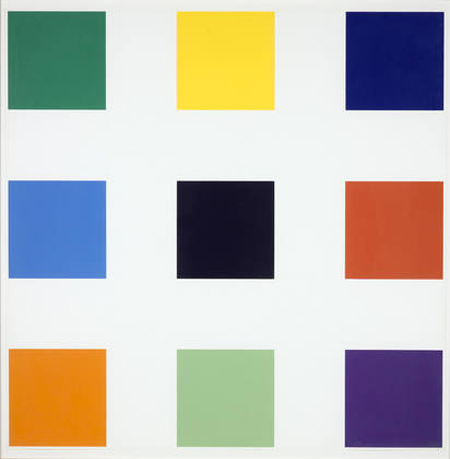
Nine Squares
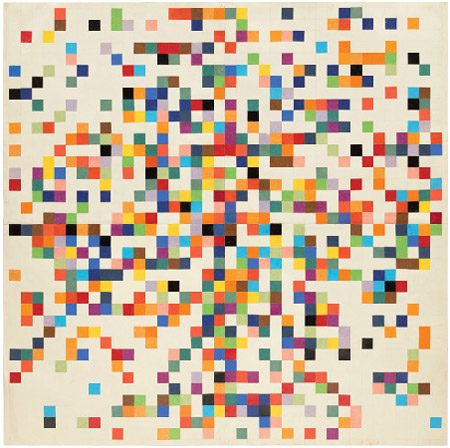
Spectrum colors arranged by chance II, 1951
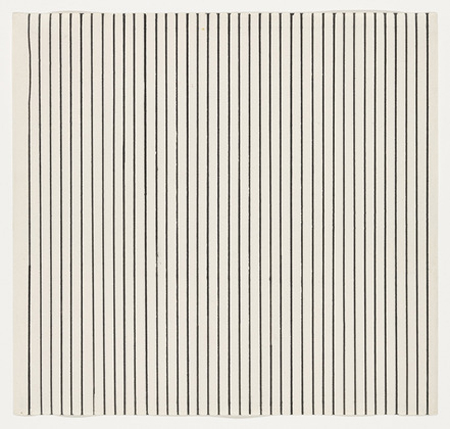
Vertical Lines from the series Line Form Color, 1951
portlandartmuseum.org